News
· Focus on Animal Health Care Product for Over 20 Years.
+86 135 9888 1411
sales@vitboo.com info@vitboo.com

Across the African continent, Mycoplasma synoviae (MS) outbreaks are rising at an unprecedented rate, and poultry farmers from Nigeria to Kenya are reporting clinical signs never before seen on this scale. New research confirms what many in the field already suspected: the pathogen is changing, and traditional control methods are falling behind.
The Alarming Rise of Mycoplasma synoviae in Africa
Mycoplasma synoviae infection in poultry has long been a concern for the global industry, but the latest epidemiological data paints a particularly grim picture for Africa. According to a landmark 2026 study published in Frontiers in Microbiology, roughly one-third of poultry populations worldwide are infected with M. synoviae, and the highest prevalence rates are reported in sub-Saharan Africa. In some regions, antibody surveys have revealed infection rates exceeding 80% in local chicken breeds and over 64% in exotic commercial breeds — figures that dwarf those reported in Europe, North America, and Asia.
The African poultry industry has experienced rapid growth over the past decade. East African nations including Kenya, Tanzania, Uganda, Rwanda, and Ethiopia have seen double-digit expansion in broiler and layer production. South Africa, Ghana, and Nigeria remain the continent's largest producers. Yet this growth has outpaced the development of biosecurity infrastructure, creating ideal conditions for Mycoplasma synoviae outbreaks to spread and intensify. Smallholder farms — which account for the majority of African poultry production — often lack access to diagnostic laboratories, veterinary support, and quality poultry health supplements, leaving flocks dangerously exposed.
The situation has drawn concern from the Food and Agriculture Organization (FAO), which has flagged sub-Saharan Africa as a priority region for improved poultry disease surveillance and control. Unlike highly visible viral outbreaks such as avian influenza, Mycoplasma synoviae spreads silently — often establishing subclinical infections that go unnoticed until production losses become severe. By that point, the pathogen has already entrenched itself in the flock.
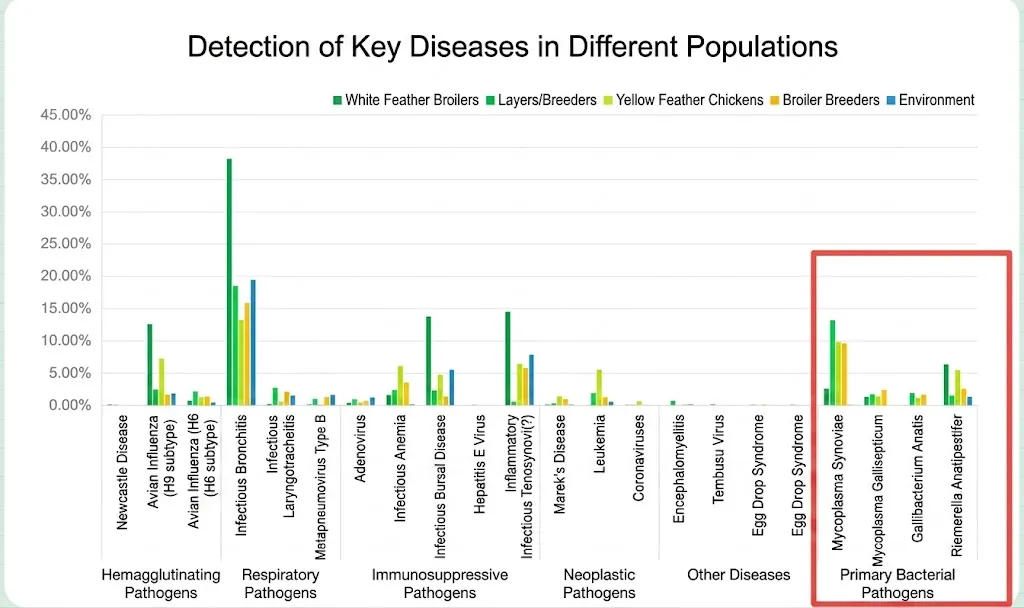
Veterinarians and poultry health experts across Africa are documenting a shift in the clinical signs of Mycoplasma synoviae that demands urgent attention. Traditionally, MS was primarily associated with infectious synovitis — a condition marked by lameness, swollen hocks and footpads, and a characteristic pale-bluish discoloration of the head in affected birds. While these classic symptoms persist, three new or increasingly prevalent manifestations are now dominating field reports:
Perhaps the most economically devastating new presentation is Eggshell Apex Abnormality (EAA), a condition in which laying hens produce eggs with thin, translucent, and structurally compromised shells at the apex. Research confirms that certain Mycoplasma synoviae strains specifically target the oviduct, causing changes in shell gland function that result in dramatically reduced egg quality, increased breakage rates, and significant economic losses for layer operations. For African egg producers already operating on thin margins, EAA can render entire batches unmarketable.
Groundbreaking 2026 research from the Guangdong Academy of Agricultural Sciences has revealed a dangerous new dynamic: Mycoplasma synoviae co-infection with Cryptosporidium baileyi produces synergistic pathogenic effects far worse than either pathogen alone. The study found a 10.55% co-infection rate in surveyed flocks, with a statistically significant positive association between the two pathogens (OR = 2.44). Chickens co-infected exhibited:
Critically, the study demonstrated that Cryptosporidium-induced immunosuppression compromises the efficacy of MS vaccines, meaning vaccinated flocks may still be vulnerable. This finding is particularly alarming for African producers who rely on vaccination as their primary line of defense.
While MS has always been capable of causing respiratory disease in broilers and layers, field veterinarians now report more aggressive respiratory presentations — including severe airsacculitis, persistent tracheal rales, and secondary bacterial complications that do not respond to conventional antibiotic protocols. The shift toward more pathogenic strain variants, combined with the immunosuppressive effects of co-infections, means birds are presenting with multi-system involvement: respiratory distress alongside joint inflammation, reduced feed intake, and sharply declining weight gain.

The financial impact of these evolving Mycoplasma synoviae outbreaks cannot be overstated. Even in subclinical cases, infected flocks suffer:
For smallholder poultry farmers in Africa — who typically operate with fewer than 500 birds — a single MS outbreak can wipe out months of income. The pathogen's ability to transmit vertically through eggs means that once a breeding flock is infected, the next generation is born carrying the disease. This perpetuates a cycle of chronic underperformance that keeps farmers trapped in low productivity.
Conventional Mycoplasma synoviae treatment relies heavily on antibiotics — primarily tylosin, tetracyclines, tilmicosin, and fluoroquinolones. However, several converging factors are eroding the effectiveness of this approach in Africa:
Antibiotic resistance is rising globally, and Mycoplasma species — which lack a cell wall — are inherently resistant to beta-lactam antibiotics like penicillin. Residue concerns are also mounting as export markets and domestic regulators tighten standards on antibiotic-free poultry production. The cost barrier of quality veterinary antibiotics puts them out of reach for many small-scale producers. And critically, antibiotics do not address the underlying immunosuppression that allows MS to flourish, particularly in co-infection scenarios.
Vaccination remains an important tool, but the discovery that co-infections can undermine vaccine efficacy means that even well-managed vaccination programs may provide incomplete protection. A comprehensive, integrated approach is urgently needed — one that combines biosecurity, nutritional support, immune enhancement, and targeted pathogen control.
In response to this evolving crisis, Vitboo has developed a comprehensive range of natural poultry health supplements specifically formulated to address the complex challenges posed by Mycoplasma synoviae and associated co-infections in African poultry production.
Vitboo's herbal poultry formulations leverage the power of traditional medicinal plants backed by modern scientific validation. Recent studies published in leading journals — including the Journal of Integrative Agriculture — have confirmed that Chinese herbal medicine formulations containing Scutellaria, Houttuynia cordata, licorice, and Astragalus demonstrate significant protective and therapeutic effects against Mycoplasma-induced respiratory disease in chickens. These natural compounds work through multiple mechanisms simultaneously:
Unlike single-pathway antibiotics, Vitboo's natural poultry immune booster formulations enhance both humoral and cell-mediated immunity. By strengthening the bird's own defense systems — including mucosal antibody production (sIgA) critical for clearing Mycoplasma from respiratory surfaces — Vitboo products help flocks resist initial colonization and clear established infections more effectively. This is especially important in the African context, where co-infections and environmental stress constantly challenge immune function.
Vitboo's respiratory health supplements for poultry contain bioactive compounds that protect tracheal and air sac epithelial integrity, reduce inflammatory damage, and support the natural clearance of pathogens from the respiratory tract. This directly addresses the severe airsacculitis and tracheal lesions now being documented in MS outbreaks across Africa.
For layer operations battling Eggshell Apex Abnormality and Mycoplasma-related production drops, Vitboo's specialized formulations support oviduct health, shell gland function, and calcium metabolism. Farmers report improved eggshell quality, reduced breakage, and faster recovery of laying rates following supplementation — critical outcomes for maintaining profitability under disease pressure. In field trials across multiple African production systems, Vitboo-supplemented flocks demonstrated measurably thicker eggshells and significantly lower rates of EAA-affected eggs compared to unsupplemented control groups.
All Vitboo poultry health products are 100% natural, antibiotic-free, and residue-free, meeting the strictest export standards for markets in Europe, the Middle East, and Asia. For African producers targeting premium and export markets, Vitboo provides a compliant pathway to Mycoplasma management without antibiotics.
Vitboo's concentrated formulations are designed for the economic realities of African poultry farming. Lower inclusion rates, superior bioavailability, and measurable improvements in feed conversion ratio, weight gain, and egg production mean that Vitboo supplementation consistently delivers a positive return on investment — even for smallholder operations. Importantly, the holistic action of Vitboo's natural formulations means farmers can reduce dependency on multiple single-purpose medications, simplifying flock management and cutting overall animal health expenditure.
Vitboo goes beyond supplying products. We provide ongoing technical support, usage guidance, and flock health management training tailored to African production conditions. Our team works directly with distributors, feed mills, and integrators to ensure proper product integration into existing feeding and management programs. This commitment to partnership has made Vitboo a trusted poultry health brand in multiple African markets, with a growing network of satisfied farmers who have successfully transitioned to natural, antibiotic-free poultry production with measurable improvements in flock performance.
Vitboo: Natural Solutions for the New Challenge
Multi-Target Immune Modulation
Respiratory Health Protection
Egg Production and Quality Support
Antibiotic-Free Compliance
Proven Cost-Effectiveness
Technical Support and Training for African Farmers

The message from the field is clear: Mycoplasma synoviae is evolving, and the African poultry industry must evolve with it. Waiting until clinical signs appear is no longer a viable strategy. The silent spread of subclinical MS infections, the emergence of EAA syndrome, and the devastating impact of co-infections demand a proactive, prevention-first approach.
Vitboo is committed to partnering with African poultry farmers, integrators, and veterinary professionals to build resilience against this growing threat. Our natural Mycoplasma treatment and prevention solutions are backed by science, validated in the field, and tailored to the unique challenges of poultry production in Africa's diverse climates and farming systems.
Whether you operate a large-scale commercial layer farm in South Africa, a growing broiler operation in Kenya, or a smallholder poultry enterprise in Nigeria, Ghana, or Tanzania, Vitboo has the poultry health supplement solution to protect your flock and your livelihood.
Contact Vitboo today to learn how our natural poultry immune boosters and Mycoplasma management products can transform your flock health and farm profitability. Don't wait for the next outbreak — build immunity, protect productivity, and secure your future with Vitboo — Your Trusted Partner in Natural Poultry Health Across Africa.
A Call to Action for African Poultry Producers
Understanding Bovine Stress Syndrome in Cattle Herds
2026-09-22Cattle and Sheep Eat but Fail to Grow? Watch for the Hidden Damage Caused by Mycotoxins
2026-09-08How to help laying hens survive the summer heat?
2026-07-23Summer Mosquito Infestation in Africa: Alert for Swine Japanese Encephalitis Outbreaks
2026-07-01Sores on your sheep's mouth? Watch out for Contagious Pustular Dermatitis.
2026-04-13Why Does the Mold Problem in Poultry Farms Worsen Despite Prevention Efforts?
2026-04-08Do you truly understand the dangers of necrotic enteritis in poultry?
2026-01-14The most common bacterial disease in poultry—E. coli infection
2026-01-06What is Newcastle disease (ND) and How to Prevent and Treat of New Castle (ND)?
2024-12-17Phone:+86 135 9888 1411
Tel:+86-0371-88959050
Email:sales@vitboo.com
Address:Zhengzhou City, Henan Province, China