
News
· Focus on Animal Health Care Product for Over 20 Years.
+86 135 9888 1411
sales@vitboo.com info@vitboo.com

Every season change brings the same warning signs to layer farms: eggshell color turns pale, shells become thin and brittle, and egg production slides day after day. Traditional Chinese poultry wisdom describes it simply — seasonal transitions drain the hen's qi and blood. Modern poultry science calls it seasonal stress in laying hens. The good news: this predictable challenge can be managed. With the right laying hen nutrition, flocks recover quickly, shells regain their color, and output returns to normal. This article explains what happens inside the bird — and how Vitboo Layer Egg Booster restores eggshell quality and laying performance through the seasonal transition.
Seasonal stress in laying hens is the physiological strain triggered by rapid shifts in ambient temperature, humidity, photoperiod, and daily management routines as seasons change. The highest-risk windows are the spring-to-summer heat transition and the autumn-to-winter cold snap, when day and night temperatures swing sharply within just a few days.
Laying hens are extremely sensitive to their thermal environment. Their optimal temperature range for egg production is 18–25°C with a relative humidity of 55–65%. When house temperature reaches 28°C, flocks enter mild heat stress: feed intake drops and respiration speeds up. When it exceeds 32°C, stress becomes severe — egg production can fall by 0.5–1% per day, and the proportion of broken eggs can double [2]. Cold stress, poor ventilation, and sudden changes in day length trigger the same cascade of stress hormones, even if symptoms develop more slowly. Even well-managed flocks show measurable responses within days: feed conversion weakens, water intake patterns change, and reproductive hormone balance shifts.
In other words, seasonal stress is not a single disease — it is a whole-body response that first shows up in the egg.
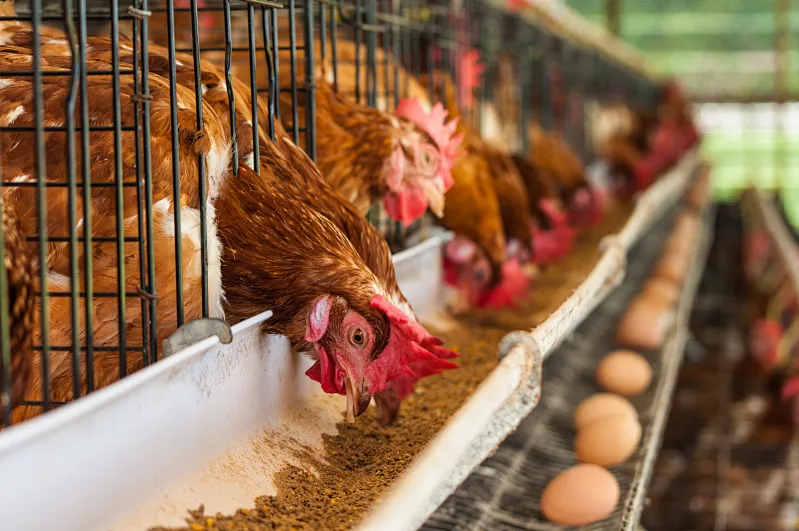
Eggshell color is produced by protoporphyrin pigments deposited onto the shell surface by the shell gland during the final hours of egg formation. When a hen is under stress, the chain of events is easy to follow:
· Stress hormones such as corticosterone rise, redirecting nutrients away from reproduction and toward survival.
· Feed intake falls, so the hen runs short of the calcium and pigment precursors needed for strong, well-colored shells.
· During heat stress, panting causes respiratory alkalosis — the loss of CO2 raises blood pH — which impairs calcium metabolism and the carbonic anhydrase activity of the shell gland.
· The result is a thinner, paler, and more fragile shell. A comprehensive review of heat stress in poultry reported average reductions of 3.24% in egg weight, 1.2% in eggshell thickness, and 9.93% in eggshell weight under elevated temperatures [4].
That is why fading eggshell color is the first warning light on a layer farm: it appears before production numbers collapse, giving producers a valuable early signal to act.
Autumn and winter bring their own challenge. Shorter daylight and colder nights reduce feed intake and slow the digestive system, so even healthy-looking hens may lay paler eggs for weeks. The pigment glands simply need more time — and more nutrients — to restore full color once conditions stabilize.
Egg production is reproduction, and reproduction is the first system a stressed hen sacrifices. Stress hormones suppress follicle development and ovulation, directly reducing the number of eggs laid. Research on commercial layers shows that egg production can decline by 10–20% during periods of heat stress [3]. The fall in laying rate is usually accompanied by:
· Smaller eggs, as nutrients are diverted away from oviduct output;
· A delayed return to peak production, because damaged follicles take weeks to regenerate;
· Poorer feed conversion, as energy is spent coping with stress instead of building eggs.
In severe cases, hens may enter a molt-like rest — and without nutritional support, the flock may never fully regain its former production curve that season.
The economics are unforgiving. For a 10,000-bird layer house, a 5% drop in laying rate means 500 fewer eggs a day — losses that multiply across the weeks it takes the flock to recover. Protecting production before the stress peak is far cheaper than rebuilding it afterward.
The saying behind this article comes from experienced Chinese poultry professionals: “seasonal change drains qi and blood; eggshells fade and egg production drops.” In traditional Chinese husbandry, qi is the vital energy that drives digestion, circulation, and immunity, while blood carries the nutrients from which eggs are built. When a flock is “drained,” the symptoms are exactly what farms see every autumn and spring: pale combs, dull feathers, faded eggshells, and falling output.
This is why traditional Chinese formulas for layers rely on qi- and blood-nourishing herbs such as Astragalus, Codonopsis pilosula, Ligustrum lucidum, Motherwort, and Wolfberry. These botanicals support digestion, strengthen immunity, and restore vitality — helping the hen's body rebuild its reserves instead of being consumed by stress. Modern feed science now combines this traditional wisdom with vitamins, amino acids, and minerals to create a more complete solution for the modern layer flock.
Nutrition alone cannot replace good management. Combine the two:
· Keep house temperature inside the 18–25°C comfort zone, and open ventilation before heat peaks arrive;
· Provide clean water at all times, and add electrolytes during hot spells;
· Maintain a stable lighting program, and avoid sudden changes in feed formula or handling routines;
· Monitor eggshell color daily — it is the earliest, cheapest indicator of flock stress.
Management fixes the environment; Layer Egg Booster repairs the body. Together they keep the flock productive through the most difficult weeks of the year.
Q: What is seasonal stress in laying hens?
A: It is the physiological strain caused by rapid changes in temperature, humidity, photoperiod, and management during season transitions. It reduces feed intake, impairs calcium metabolism, and suppresses egg production until the flock's reserves are restored.
Q: Why are my hens' eggshells pale?
A: Pale shells usually mean the hen cannot deposit enough protoporphyrin pigment or calcium onto the shell, typically because stress hormones and reduced feed intake interrupt normal shell formation.
Q: How quickly does eggshell color recover with Vitboo Layer Egg Booster?
A: Shells typically become brighter within 3–5 days, and a 15-day course every two months can reduce broken shell eggs by about 90%.
Q: Can Layer Egg Booster be used for ducks and geese?
A: Yes. It is formulated for chickens, ducks, and geese.
Q: Is Layer Egg Booster a medicine?
A: No. It is a natural, antibiotic-free poultry feed additive for nutritional support. For disease situations, consult a veterinarian.
Seasonal stress in laying hens is predictable — and preventable. The fading eggshell color and falling egg production that appear every year are the flock's cry for help, and they respond quickly to the right support. Vitboo Layer Egg Booster combines modern nutritional science with the traditional wisdom of qi- and blood-nourishing herbs to protect eggshell quality, maintain the laying rate, and extend the profitable production peak.
Contact Vitboo today for pricing, technical support, and OEM cooperation. Vitboo — your trusted partner in natural poultry health.
[1] Vitboo — Layer Egg Booster product page
[2] China Animal Agriculture Association (CAAA), “伏天产蛋稳,降温是核心!”
[3] SR Publications, “Strategies to Reduce Heat Stress in Commercial Layers”
[4] “Thermoregulation and Physiological Responses to Heat Stress in Poultry: A Comprehensive Review”
[5] Kalmbach Feeds, “Heat Stress in Chickens: Signs, Treatments, & Prevention Methods”
Phone:+86 135 9888 1411
Tel:+86-0371-88959050
Email:sales@vitboo.com
Address:Zhengzhou City, Henan Province, China
