
News
· Focus on Animal Health Care Product for Over 20 Years.
+86 135 9888 1411
sales@vitboo.com info@vitboo.com

Infectious bursal disease (IBD) is an acute, highly contagious disease in chicks caused by the IBDV. Characterized by sudden onset, rapid spread, a short course, and a spiky mortality rate, IBD is one of the major infectious diseases that severely impact the poultry industry.
Infectious Bursal Disease
(I)Clinical Symptoms
The incubation period of this disease is 2 to 3 days.
Chickens suddenly become ill, pecking at their cloaca, becoming listless, with ruffled feathers, drooping wings, tremors, drowsy eyes, and an unstable gait. In severe cases, they lie down and motionless in a tripod posture.
The appetite decreases or disappears, the amount of water consumed increases dramatically, the cat has yellow-white milky or watery feces, and the feathers around the cat are contaminated with feces.
In the middle and late stages of the disease, sick chickens become slow to respond or stop responding to external stimuli, their body temperature drops, they huddle together, hang their heads, lie on the ground, become severely dehydrated, and die of extreme weakness.
(II)Pathological Changes
The body is dehydrated, the chicken feet are dry, and the muscles are dull and lifeless.
There are bleeding spots or spots on the leg and chest muscles, which appear in brush or stripe shapes.
The kidneys may swell and bleed to varying degrees, often with a red and white mottled appearance due to urate deposits. Urate deposits may also be present in the ureters, which may block the ureters in severe cases.
The bursa is edematous and hemorrhagic, more than twice the normal size. In severe cases, it becomes purple-black grape-shaped and gradually shrinks after 5 days. The mucus in the bursa increases, the mucosal folds are turbid, and there are punctate or diffuse bleeding on the mucosal surface. In severe cases, there is creamy or cheesy exudate in the bursa.
There are streaky bleeding at the junction of the gizzard and glandular stomach.
The liver is yellow-gray or khaki, and after death, due to compression by the ribs, it becomes red and yellow stripes, with infarcts around it.
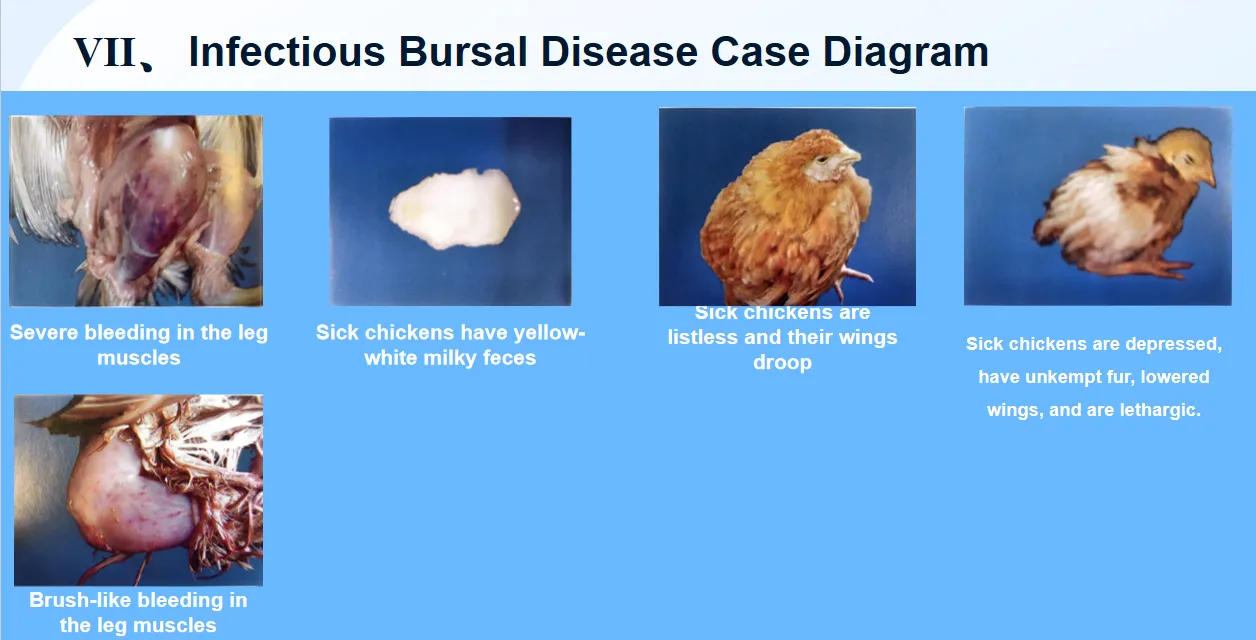
Sick chickens show depression
Diarrhea in sick chickens (white watery stool)
Phone:+86 135 9888 1411
Tel:+86-0371-88959050
Email:sales@vitboo.com
Address:Zhengzhou City, Henan Province, China
