
News
· Focus on Animal Health Care Product for Over 20 Years.
+86 135 9888 1411
sales@vitboo.com info@vitboo.com

Mycoplasma synoviae poses a significant threat; how can poultry farmers effectively control and prevent it?
Swollen joints and lameness in chickens? How to diagnose and treat mycoplasma synoviae infection?
Let's approach today's article with some questions in mind.
Mycoplasma Synoviae Infection
(I)Clinical Symptoms
(II)Pathological Changes
The primary lesion is synovitis of the joints and keels. Joints swell and the synovium thickens. Initially, the joint fluid increases in volume, becomes translucent, and viscous. In the middle stages, it becomes a pale yellow, gelatinous exudate. Later, it becomes pus or a yellowish-white, cheesy exudate. Exudate is often present in the tendon sheath and synovial bursa (similar to avian viral arthritis).
Some cases may have cysts and hemorrhages in the chest keel, jelly-like effusions, and respiratory tract cases may have inflammatory lesions. Sometimes there may be hepatosplenomegaly, kidney enlargement, pale color, and atrophy of the thymus and Fasciola.
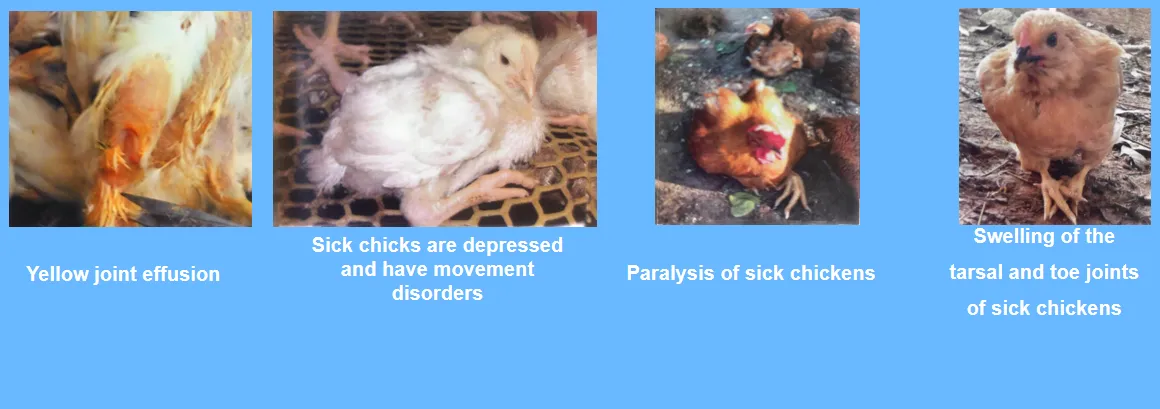
Case Diagram of Mycoplasma Synoviae Infection
How to Quickly Determine Whether the Disease is Mycoplasma Synoviae Infection?
Joint Swelling:It often occurs in the hocks, foot pads, or wing joints and may be accompanied by lameness or difficulty standing.
Respiratory Symptoms: Mild cough, sneezing, or sinus swelling (similar to Mycoplasma gallisepticum infection, but usually milder).
Impact on Egg Production:The egg shell quality is reduced (such as thin-shell eggs and sandy-shell eggs), and the egg production rate may be reduced.
Yellow or grayish white viscous exudate can be seen in the joint cavity, and the synovial bursa is thickened and edematous.
Chronic cases may present with articular cartilage erosion or fibrosis.
Prevention Options for Mycoplasma Synoviae Infection
Vector Control:
Prevent birds, rats, mosquitoes and flies, and avoid mechanical transmission of pathogens.
Personnel and Equipment Control:
Strictly limit the movement of people within the facility, and disinfection (such as changing shoes and clothes and washing hands) is required upon entry and exit.
Shared equipment (egg baskets, feed carts, etc.) must be thoroughly cleaned and disinfected.
Immunization Management:
Vaccination: Use an inactivated MS vaccine (such as the MS-H strain) for chicks, initially administered between 1 and 3 days of age, followed by a booster vaccination 2 to 3 weeks later. Layers or breeders can be vaccinated again before laying to reduce the risk of vertical transmission.
Immune Boosting: Add vitamins A, C, and E or beta-glucan to boost the flock's immunity.
Phone:+86 135 9888 1411
Tel:+86-0371-88959050
Email:sales@vitboo.com
Address:Zhengzhou City, Henan Province, China
